

GP. Korea: Ferrari also use the Polysil
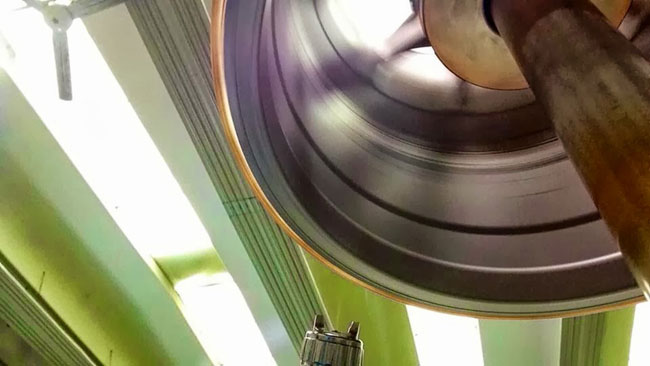
There had already spoken before the Singapore Grand Prix on the use of Polysil the rims to try to bring to the correct temperature in a short time the tires Discovered the material used inside of the rims: It called Polysil. The images seen today in the pits of Korea we can see that Ferrari uses this material that is produced by a company in Sassuolo called Nanoprom. The material used is a kind of liquid glass with black opacifying pigment that is used to improve the thermal conductivity and it is created primarily for the market for the nautical. It is a based on atomic silicon coating with revolutionary features that allows the protection of reconditioning the substrate surface structure. With a layer of a few microns high surface hardness (9H) ,the surfaces also have a high resistance to abrasion. This “liquid glass” weighs 95% of a normal painting and has a resistance to temperatures of 1100 ° C. Currently the color coatings of a wheel of Formula 1 weigh from 65 to 85 grams. Thanks to this product the coating weighs only 5 grams and in addition to improving thermal conductivity gave an improvement of 3 points to the CFD as are generated less turbulence.
[Source: F1AnalisiTecnica.com] Read MoreFerrari: here is the circle that heats the tires
The Polysil nanotechnology is produced in Sassuolo, and allows you to retain the heat of braking
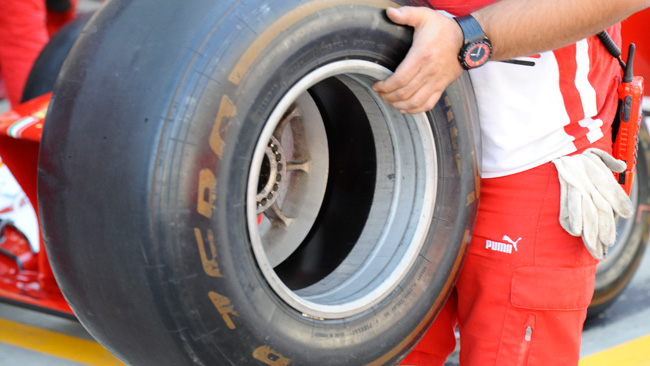
here is a circle of Ferrari F138 showing inside the coating which it was adopted for retain the temperature which allows it to also heat the tires. The wheel absorbs the heat (you get up to 200 degrees) that is given off by the brake discs in detached and which is usually disposed of as quickly as possible with special ducts, now assumes a secondary function which is becoming increasingly important with current Pirelli tires. Each team now adopting different techniques and materials. The OZ Racing It has closed an important collaboration with the NANOPRO, a specialized company based in Sassuolo (a few steps from Reparto Corse Ferrari) which produces the Polysil: the partnership is active in Formula 1 by Gp Malaysia, but it was cleverly kept hidden… Polysil It is a product designed for boating (Maserati has been a technical partner, the boat of Giovanni Soldini) for the protection of surfaces, consisting of polymer-based structures (gelcoat and paints), metals, alloys and glass, while in Formula 1 He has found another brilliant program: It is a silicon film formed by nanotechnology useful to keep the heat of the circle just what you need to team seeking the competitiveness of the tires from the first lap on qualifying. You spray what is considered a “liquid glass” on the circle: the effectiveness is guaranteed by a layer of a few microns for the high surface hardness of this material which also ensures a high abrasion resistance. The traditional painting a F1 wheel costs about 65 grams, while Polysil go down dramatically just 5 grams! This product in addition to limiting the thermal conductivity has also given some aerodynamic advantage since the application allows to reduce the turbulence generated in the circle. The technicians of the Formula 1 They are considering what other applications may have this nanotechnology, which we will be seeing…
[Source: OmniCorse.it]
Read MoreNANOPRO: Aquaspeed for superfast hulls
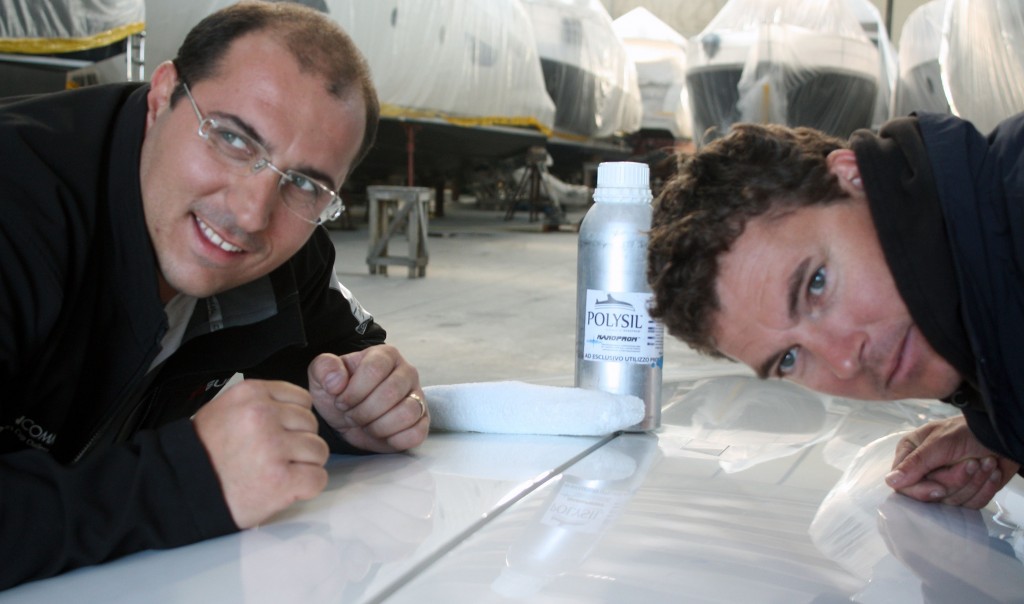
Sassuolo- NANOPRO, manufacturer of molecular nano polymers for the treatment of all parts of vessels, It is achieving excellent results in the world of racing with his new Aquaspeed. It is a polymer that nanomolecular, lay hands on the work, It creates a self-leveling film that reduces friction in water. It is also used to treat upper works by decreasing the resistance of the water over the sides in the same beat and slide off the deck or rain splashes. Both products, based nanotechnology, They are developed by Nanoprom laboratories for Aquatic line.
Nanoprom was the technical sponsor of Fremito d'Arja during the Melges 20 Gold Cup organized in the Gulf of Naples at the beginning of November. The hull of the Melges 20 Levi-Casale-Lagi trio, winner of the event, It was treated with Aquaspeed to increase its effect on the water slipping.
Almost simultaneously, the Nautical Club of Pescara hosted the European Ufo 22. Nanoprom has equipped Mini Man, the boat Riccardo Di Bartolomeo (Also in the crew Enrico Zennaro and Simone Ferrarese), which won the international competition. Even in this case it was used Aquaspeed for the treatment of the hull.
Recall that Nanoprom is also a technical partner of the Italian Sailing Federation.
[Source: farevela.net By Federico Maselli ]
Read More
Search & Development - Reduce friction with nanotechnology
After years of research, field testing and automotive applications, industrial and marine, Nanoprom presents an innovative product in the market: Polysil Top Coat F1, a protective coating the hull of each boat, or sail, o planing dislocante, which drastically reduces the friction with the water providing better performance at the same applied pressure. Underlying Polysil Top Coat F1 there are nano molecules: thanks to this particular technology, the product applied to the hull levels itself and adheres perfectly to the treated surface,Following each interspace between the same molecules and thus preventing water to penetrate and form friction, through the modification of the surface tension. There are many other advantages of nano-molecular structure and composition of Polysil Top Coat F1 provide in case of application alive on the work. The first tests carried out in the tank by the University of Trieste have shown, numbers in hand, that the actual reduction in the water resistance on the treated surface is on average 14%, with peaks 17% in low velocity areas (transient, or low-average load of power required). The test was carried out on flat plate, ie in the typical mode for this type of test,. The graph shows very clearly the decrease in resistance due to friction of water on the hull. On the x axis the speed in meters / second (the equivalent in knots is obtained by multiplying 1,94, or nearly 2). The y-axis resistance in kilograms-force in the two cases. In the case of tub-sea data transfer, secondo le procedure dell’I.T.T.C., it can be stated with good approximation that the speed range from 0 a 12 nodes to the case should be 0 a 50 knots.
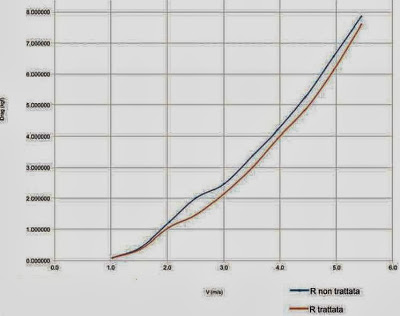
resistance chart with Polysil
This means that the concrete benefits of Polysil Top Coat F1 are found on most boats on the market, sailing and motor, dislocanti e plananti. Definitely, in applied power parity (engine or wind) friction is reduced by an average of 14%. In other words, The speed increases accordingly. But, reversing the concept, you get a reduction of fuel consumption for motor boats, at constant speed.
[Source: nautechnews.it]
Read MoreBoat Show 2012: gliding on the water with Polysil Top Coat F1 Nanoprom
Genoa- NANOPRO, manufacturer of molecular nano polymers for the treatment of all parts of vessels, It presents on the occasion of the Boat Show 2012 il Polysil Top Coat F1, a product designed EPR increase the racing hulls performance. Polysil Top Coat F1 is a the hull protective coating that dramatically reduces friction with water, providing better performance at the same applied pressure.
At the base are the nano molecules: thanks to this particular technology, the product applied to the hull levels itself and adheres perfectly to the treated surface, Following each interspace between the same molecules and thus preventing water to penetrate and form friction, through the modification of the surface tension.
As measured by Nanoprom, the first tests carried out in the bath by the University of Trieste have shown that the concrete reduction in the water resistance on the treated surface is on average 14%, with peaks 17% in low velocity areas (transient, or low-average load of power required).
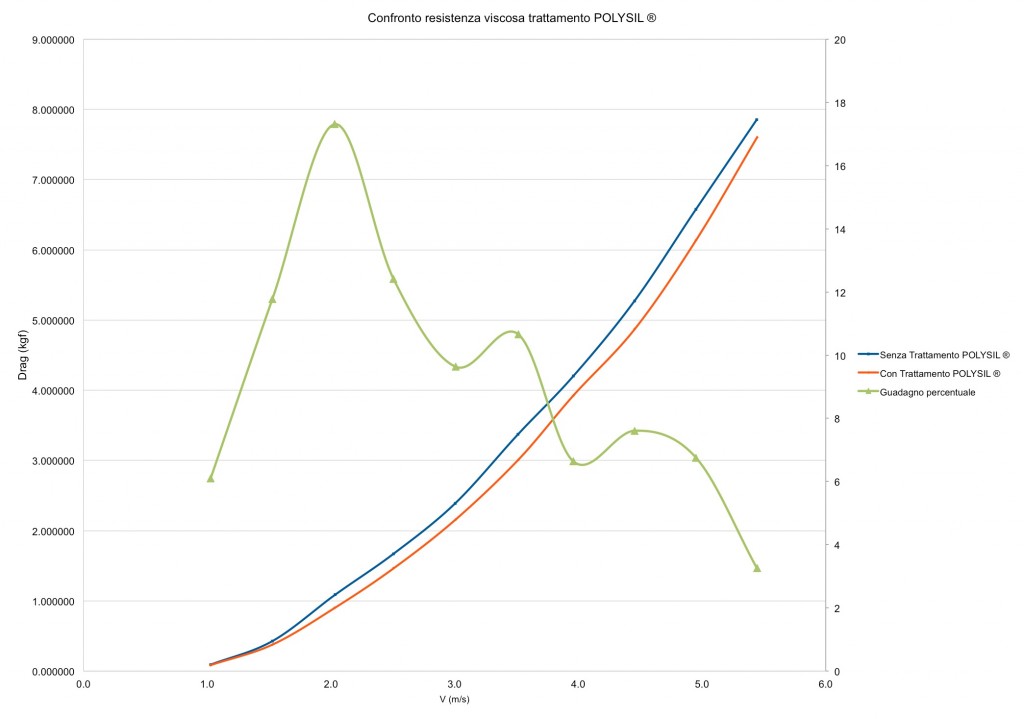
The graph shows the decrease in resistance due to friction of water on the hull. On the x axis the speed in meters / second (the equivalent in knots is obtained by multiplying 1,94). The y-axis resistance in kilograms-force
In the case of tub-sea data transfer, secondo le procedure dell’I.T.T.C., the company says that the speed range from 0 a 12 nodes to the case should be 0 a 50 knots. If the forecast is confirmed, This would mean that the tangible benefits offered by Polysil Top Coat F1 would be found on most boats on the market, sailing and motor, dislocanti e plananti.
In the product there are no toxic substances because the base constituting the product is liquid glass and the rest is done by nano-molecular structure. Are therefore absent altogether poisonous contrails released in water, as well as of processing waste which would require an application in shipyards equipped to the treatment of toxic waste.
To apply the product alive on the work of a drift or high ground, there is no need to heat or to sophisticated paint systems. The nano molecules are self-leveling, that stretch from the sun in the most compact position, filling every possible interspace surface of the hull and between them.
Since the compound is colorless, Polysil Top Coat can be applied without distinction of parts of the hull colored differently, no aesthetic impact.
[Source: farevela.net]
Read More


