

After years of research, field testing and automotive applications, industrial and marine, Nanoprom presents an innovative product in the market: Polysil Top Coat F1, a protective coating the hull of each boat, or sail, o planing dislocante, which drastically reduces the friction with the water providing better performance at the same applied pressure. Underlying Polysil Top Coat F1 there are nano molecules: thanks to this particular technology, the product applied to the hull levels itself and adheres perfectly to the treated surface,Following each interspace between the same molecules and thus preventing water to penetrate and form friction, through the modification of the surface tension. There are many other advantages of nano-molecular structure and composition of Polysil Top Coat F1 provide in case of application alive on the work. The first tests carried out in the tank by the University of Trieste have shown, numbers in hand, that the actual reduction in the water resistance on the treated surface is on average 14%, with peaks 17% in low velocity areas (transient, or low-average load of power required). The test was carried out on flat plate, ie in the typical mode for this type of test,. The graph shows very clearly the decrease in resistance due to friction of water on the hull. On the x axis the speed in meters / second (the equivalent in knots is obtained by multiplying 1,94, or nearly 2). The y-axis resistance in kilograms-force in the two cases. In the case of tub-sea data transfer, secondo le procedure dell’I.T.T.C., it can be stated with good approximation that the speed range from 0 a 12 nodes to the case should be 0 a 50 knots.
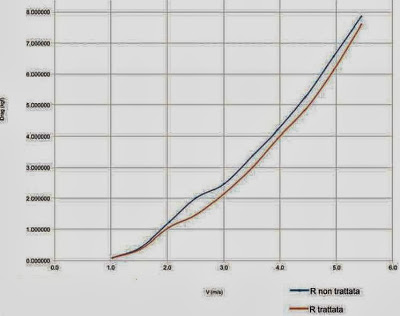
resistance chart with Polysil
This means that the concrete benefits of Polysil Top Coat F1 are found on most boats on the market, sailing and motor, dislocanti e plananti. Definitely, in applied power parity (engine or wind) friction is reduced by an average of 14%. In other words, The speed increases accordingly. But, reversing the concept, you get a reduction of fuel consumption for motor boats, at constant speed.
[Source: nautechnews.it]


