

that of NANOPRO, company specializing in nanotechnology Sassuolo (MO), is a technology already quite established in the naval world before and Formula 1 then. Their flagship product, the Polysil®, “is a silicon vehicle added of nanoparticles according to the characteristics that we want to give” He explains the holder, Gian Luca Falleti.
Initially, the product of the company has dug in the world shipbuilding industry, for its performance and qualities of resistance, and then move to the mainland: “What resists at sea, the earth endures 4 times more”, He resumes the holder, and so came the application to the world of cars. In water the Polysil®, among its other properties, It reduces friction, the same on the mainland: on Formula cars 1 It is used on the one hand for the painting of the bodywork, making it lighter (It weighs less than conventional paints), on the other hand to prevent the hot asphalt rubber will stick to the bodywork.
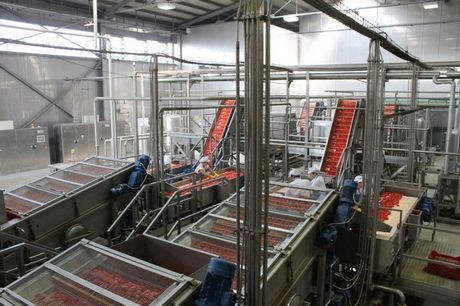
The processing plant of Solana tomato. (photo Solana)
From here it has come in a short passage to the food industry and Solana, a company of Lodi specialized in the transformation of the industrial tomato, He chose this nanoparticle technology to its production facility: the Machinery surfaces were coated Polysil® “avoiding – continua Falleti – oxidation by air and the passage of the tomato, while the adhesion of dirt conveyed by water is more difficult to an extent of 80%. Compared to a traditional coating, fluid runs off more quickly without leaving residues and where there is water there is life, even that of bacteria”. The result is an aseptic unit and easier cleaning.
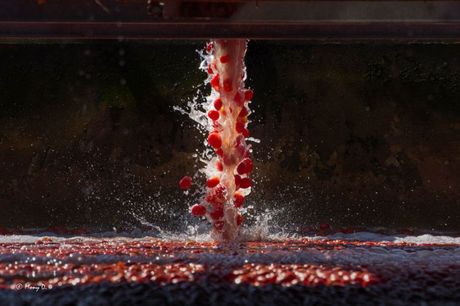
The processing plant of Solana pomdoro. (photo Solana)
“The same technology – He concludes the holder of Nanoprom – we use it even in the freezer (for now only civilian, ed) for the coating of the coils. Since this is a coating of a few microns, he was born in 90% thinner than a traditional coating layer; this allows the system a higher resistance to corrosion and a lower formation of ice in the order of 17%, with significant energy savings so that the process works so they can move from one energy class A to A +, however, without the use of the paint ovens”.
Publication date: 20/10/2016
Author: Andrea Minghelli
Copyright: www.freshplaza.it


