

In Formula 1 Nanoprom has made a name for itself thanks to Polysil, the black silicon nanotechnology that already in 2014 it was adopted by many teams to improve the thermal transmittance of the rim and help bring the tires into the right working window.
Some time has passed since then, but the dynamic company from Sassuolo has evolved and made large investments in the field of chemistry, so much so that now it is ready to revolutionize not only the world of Grand Prix with a solution destined to cause much discussion.
The researchers of Gian Luca Falleti, indeed, have studied in the laboratory of Nanoprom Chemicals a new product destined to change the concepts known up to now on the protection of surfaces from a heat source.
Grazie al Polysil Thermal Shield 2.8 today it is possible to reduce the temperature generated by an open flame up to 65%, by changing the approaches to cooling and safety fees in an endless field of applications.
Falleti worked on the most difficult materials to treat such as carbon and glass composite fibers, not to mention kevlar and nomex too.
Carbon fiber subjected to high temperatures usually loses its characteristics of great stiffness and delaminates. The experimental data that are emerging, instead, they are simply amazing, so much so that the Nanoprom solution is obtaining approvals for use in the aerospace field.
Deeply impregnating carbon is one of the problems faced, since it is difficult to convey the material between one fiber and another. Through a pre-treatment with a process developed by Nanoprom, the technicians were able to penetrate the carbon fibers with their product, eliminating the 100% epoxy resins.
What an advantage it has given? Having an extraordinary resistance to flame unthinkable until today.
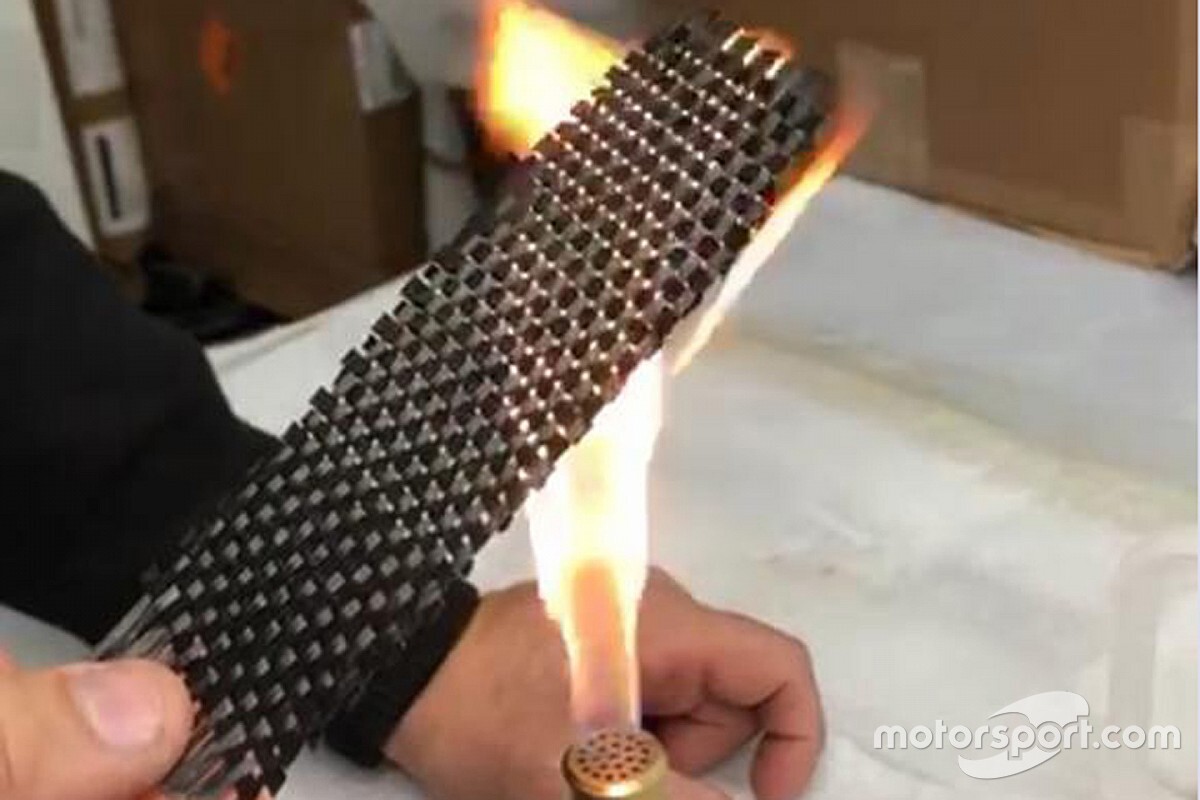
“A carbon bulkhead of 4 layers - explains Gian Luca Falleti – has the ability to break down the heat exchange of the 65% and has a resistance of over 100 minutes over a direct flame. The first thing that was noticed experimentally was the total lack of smoke generated by the compound. If the flame temperature has reached almost 700 degrees, on the upper wall of the carbon bulkhead the i 300 degrees after half an hour of exposure to the heat source ".
How did you get these results in the lab?
“After laminating the carbon with our silicon resin with some bonds that are obviously top secret, we introduced it into the plasma machine and with the high vacuum we were able to eliminate all forms of solvent that, otherwise, it could feed the flame and make our protection ineffective ".
“Thanks to Plasmatech and our collaborators we have managed to obtain a great result not only on carbon, but also on the glass fiber which can achieve an important structural seal. With the Polysil Thermal Shield there is no carbon delamination: the plot remains unchanged, without damage or creasing of the fibers. Not only that, but there is no heat propagation, so the high temperature is limited to the area immediately facing the flame, but it does not extend to the lamina ".

Test with carbon sheet treated by Nanoprom and exposed to open flame: the heat of 700 degrees does not propagate
You have also experimented with 2 layers of kevlar e 4 by nomex, 2 for part to cover and what results have emerged?
"That after 1 minute the surface subjected to direct flame maintained a temperature of 40 degrees, which then only rose to 80 degrees later 2 minutes and stabilized around 100 degrees upon expiry of 3 minutes ".
It is inevitable to immediately think about the fireproof clothing of the pilots that only thanks to a different treatment could allow much longer rescue times in the event of an accident without the driver reporting any burns due to flames or heat.!
But remaining in the field of F1 one would think how miniaturized the cooling systems of the power unit could be, reducing the radiant masses to the advantage of a lower resistance to advancement e, then, higher top speed. Not only, but the heat shields are also used to "dress" the heat engine and promote better fluid dynamics inside the bellies. Therefore, in addition to reliability, performance could be sought.
Another sensitive area is that of the hybrid battery: the famous carbon "suitcase" located under the tank and the driver's seat could be even better protected and insulated, since it needs to be cooled. IS, here a direct connection with the automotive world is immediately opened. It will be interesting to understand who will be able to exploit this very innovative nanotechnology first ...


